Solving Basement Leaks from the Inside
Does a wet basement mean having to dig up the yard and spend tens of thousands of dollars? For most poured concrete foundations, professional basement waterproofing Staten Island solutions can be completed entirely from the inside without tearing apart driveways, porches, or mature landscaping. When groundwater seeps into a basement, moisture almost always follows narrow settlement cracks or the cold-joint seam where the wall rests on the footing. Understanding how water enters a home and how targeted interior repairs work allows property owners to solve water intrusion permanently while protecting property value.
Many property owners dread calling a contractor because many believe foundation repairs always require massive excavators parked on the front lawn. Exterior excavation involves digging a continuous trench down to the foundation footing, dismantling wooden decks, and removing established shrubbery. Fortunately, modern foundation restoration techniques allow specialists to address the exact entry pathways of water directly from within the basement itself.
Homeowner Fundamentals: What Causes Basement Leaks in Staten Island Homes
Staten Island has unique coastal ground conditions, including pockets of dense clay soil that absorb and hold large amounts of water after rainstorms. When sustained precipitation saturates the ground, water cannot drain away quickly and creates outward hydrostatic pressure against subterranean foundation walls. Poured concrete is an exceptionally durable building material, but as water collects against exterior surfaces, the moisture seeks out any minor pathway into the interior space.
During initial home construction, concrete naturally shrinks as moisture evaporates during curing, often forming thin vertical hairline fissures. Additionally, decades of natural ground settling place subtle physical stress on foundation walls. While these hairline cracks are usually harmless structurally, they can act as open channels for pressurized groundwater when the surrounding soil becomes saturated.
Many property owners assume that seeing water on a basement floor means the entire foundation has failed and requires massive construction. In reality, most water intrusion originates from one or two isolated cracks or the joint between the floor slab and foundation wall. Identifying the exact entry point prevents property owners from paying for unnecessary excavations or invasive drainage systems that do not address the true source of the leak.
Why Quick DIY Surface Patches Always Fail
When water trickles through a basement wall, many property owners or general handymen attempt a quick fix by applying hardware-store hydraulic cement or silicone caulk over the crack. While surface patching may temporarily stop moisture for a few weeks, the repair inevitably fails once heavy rains return. Understanding why surface patches fail helps property owners avoid repeat leaks and wasted repair budgets.
- Surface Patches Leave the Internal Void Open: Applying cement paste or caulking over the interior face of a crack only covers the surface, leaving eight to ten inches of cracked concrete behind it completely unsealed and full of moisture.
- Hydrostatic Pressure Pushes Surface Plugs Off: Water sitting against the exterior wall builds continuous pressure that easily breaks the bond of non-elastic surface mortar, causing the patch to pop off or flake away.
- Water Migrates Around the Blocked Area: Because the crack remains open through the wall, water simply travels sideways through tiny channels in the concrete and emerges through new cracks or along the floor seam.
Retail expanding foam kits sold in aerosol cans suffer from similar durability issues over time. While spray foam expands rapidly during application, the material cures into a soft, porous cellular structure that breaks down after repeated exposure to mineral-rich groundwater. Over two or three seasons, the foam softens and shrinks, allowing water to trickle through the wall once again. A lasting repair requires sealing the entire depth of the concrete rather than merely hiding the crack behind a surface barrier.
How Interior Epoxy Injection Seals Wall Cracks Permanently
Professional foundation repair relies on structural epoxy injection to seal poured concrete cracks from the inside without exterior excavation. Rather than simply covering the crack, high-pressure injection pumps liquid polymer resin through the entire eight-to-ten-inch thickness of the foundation wall. The liquid resin flows into every microscopic branch of the fracture, pushing out trapped moisture and air until it fills the void from the interior wall face to the outside soil.
The installation process begins by thoroughly cleaning the concrete surface to remove dust, loose particles, and mineral efflorescence. Technicians then install injection ports at measured intervals along the length of the fissure and apply a temporary high-strength surface paste to contain the resin during pumping. Once the paste hardens, technicians inject low-viscosity liquid epoxy under controlled pressure, starting at the lowest port and progressing upward as the resin fills the crack and appears at the next port.
Within several hours, the injected epoxy cures into a solid, waterproof mass that chemically bonds to the concrete aggregate on both sides of the crack. The cured epoxy possesses higher tensile and compressive strength than the original concrete wall, effectively fusing the two sides back into a single monolithic barrier. This process permanently stops water infiltration, restores wall integrity, and leaves outdoor lawns, stone patios, and shrubbery completely undisturbed.
Comparing Residential Basement Waterproofing Options
Waterproofing Method | Typical Application | Yard & Home Disruption | Primary Benefit | Expected Durability |
Interior Epoxy Injection | Poured concrete wall cracks & tie rod holes | Zero disruption; all work completed from inside | Fuses full wall depth; stops water at the source | Permanent lifetime seal |
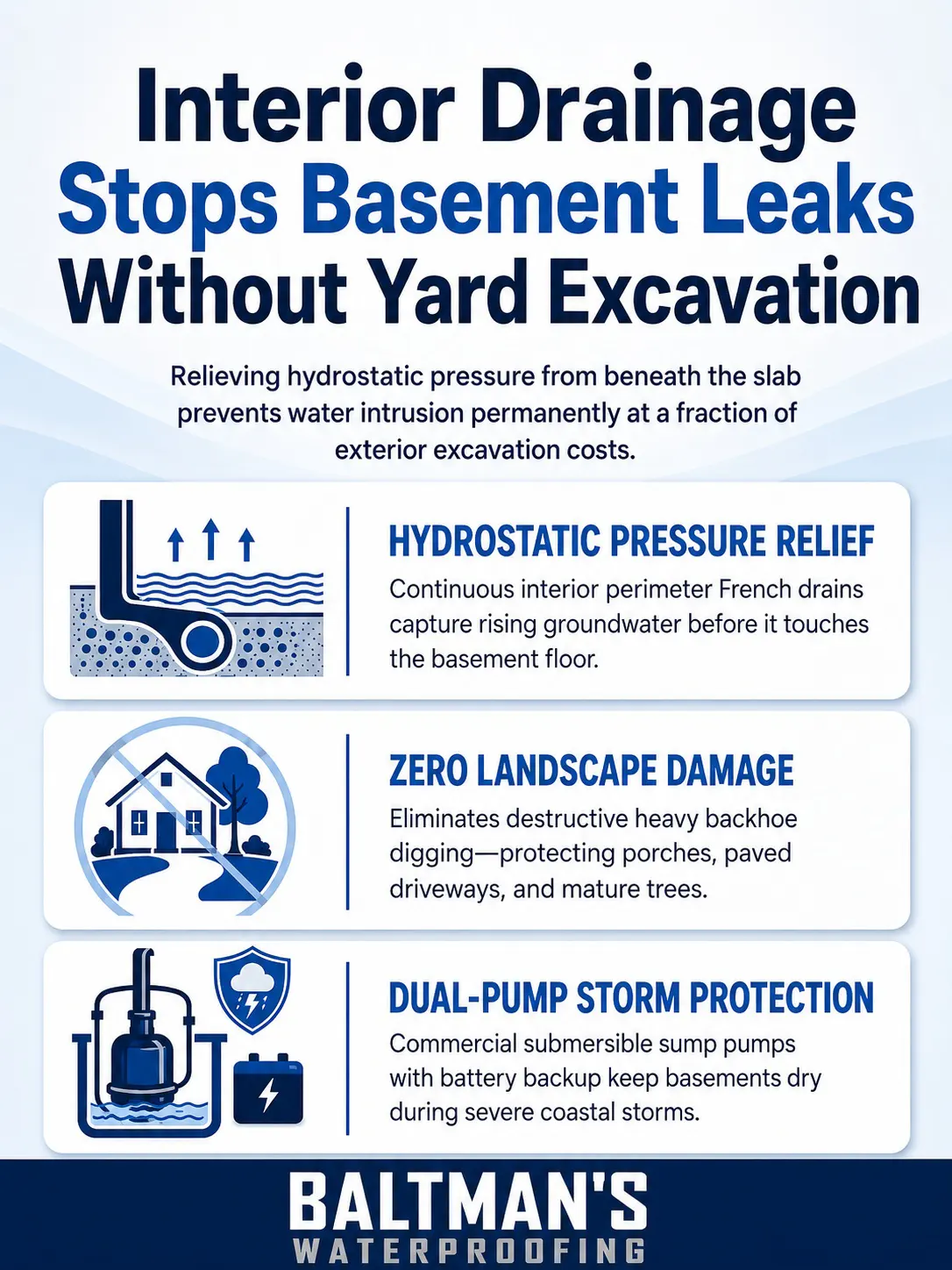
Interior French Drain & Sump Pump | Rising groundwater at floor-wall seam | Moderate; requires breaking basement floor edge | Relieves under-floor water pressure | Long-term with regular pump maintenance |
Exterior Trench Excavation | Severe masonry block deterioration | Heavy; requires digging 6-8 ft trenches outside | Adds new membrane to exterior wall surface | 15-20 years depending on backfill soil |
DIY Surface Hydraulic Cement | Emergency temporary spot patching | None; applied by hand to interior crack face | Inexpensive quick fix for minor weeping | Temporary; typically fails within 3 to 12 months |
Field Inspection Steps Before Calling a Foundation Professional
Before scheduling a contractor inspection, take a few minutes to examine the property to learn where the water is coming from and how urgent the problem is. Homeowners can check three practical checkpoints around the house to better understand the moisture issue. Noting these observations will help technicians provide an accurate assessment during an on-site evaluation.
- Inspect Gutters and Downspouts: Ensure roof gutters are clear of leaves and downspouts discharge rainwater at least five to six feet away from foundation walls to prevent water pooling against the house.
- Locate the Exact Water Entry Point: Look closely at whether water is trickling down a specific vertical wall crack, seeping through a tie rod hole, or bubbling up along the seam where the floor meets the wall.
- Note the Timing of the Leak: Observe whether water appears immediately during a sudden downpour, which often indicates roof runoff issues, or several hours later as groundwater rises in the surrounding soil.
Documenting these details helps technicians determine whether a basement issue stems from surface drainage, a localized wall fracture, or perimeter hydrostatic pressure. Taking clear photos or short videos while the leak is active also gives inspectors helpful context if the basement has dried out by the time an inspection takes place. These observations help foundation specialists pinpoint the exact cause of moisture and design the most cost-effective repair solution.
Get Honest Foundation Advice from Altman's Waterproofing
Dealing with basement moisture does not require accepting disruptive excavation bills or relying on temporary surface patches that fail during the next storm. For poured concrete foundations on Staten Island, full-depth structural epoxy injection provides a clean, permanent solution that stops leaks at the source while keeping outdoor landscaping intact. By addressing the internal void directly, property owners protect finished living spaces, eliminate persistent dampness, and restore lasting peace of mind.
Altman's Waterproofing has specialized in residential foundation crack repair and basement waterproofing across Staten Island since 1992. Our experienced team evaluates each home with honest, practical guidance, identifying whether a leak requires targeted crack fusion, joint sealing, or simple exterior drainage adjustments. To schedule an on-site foundation inspection and discuss permanent interior crack repair solutions for a Staten Island home, contact Altman's Waterproofing at (917) 681-3146.
Related Reading