A basement crack is not automatically a crisis. Some small, dry, stable cracks can be watched, especially if they have not changed over time and no moisture is present. But deciding whether you can handle a crack yourself or need basement crack repair Staten Island homeowners can rely on comes down to one question: is this just a visible surface crack, or is it a water path through the foundation?
That distinction matters because a homeowner may be able to fill what they can see. The harder part is knowing what the crack means. How deep does it go? Is water moving through it? Has the wall shifted? Is the surrounding concrete still sound? A neat-looking patch does not answer those questions.
A Crack Is Evidence, Not Just a Line in the Wall
Concrete can crack for many reasons, and not every crack means the foundation is failing. A narrow, dry, vertical crack that has not changed may be something you photograph, measure, and monitor.
The concern begins when the crack starts telling a different story. If it does any of the following, you are no longer dealing with merely a cosmetic issue.
- It leaks after rain.
- It leaves dark staining.
- It shows white mineral deposits.
- It smells damp.
- It keeps returning after patching.
The National Ready Mixed Concrete Association notes that residential basement wall cracks should be evaluated based on more than appearance, including leakage, measurable displacement, width, wall thickness, reinforcement, and design standards.1 Two cracks that look similar from across the room may require very different decisions.
What DIY Patching Can Reasonably Do
DIY patching can make sense in limited situations. If the crack is dry, small, stable, and not connected to dampness, a homeowner may choose to seal the surface to reduce dusting, improve appearance, or keep an unfinished basement cleaner. That is not a foolish decision, but it does have its limitations.
Most DIY products deal with the accessible face of the wall. They may cover the line, fill a shallow gap, or create a cosmetic seal. For a truly inactive crack, that may be enough for the homeowner’s goal.
The problem is expecting a surface patch to solve a crack that is carrying water. Water does not care whether the wall looks repaired from the basement side. If moisture is still moving through the crack behind the patch, pressure and repeated wetting can cause the repair to blister, soften, separate, or leak again.
When You Should Contact a Professional
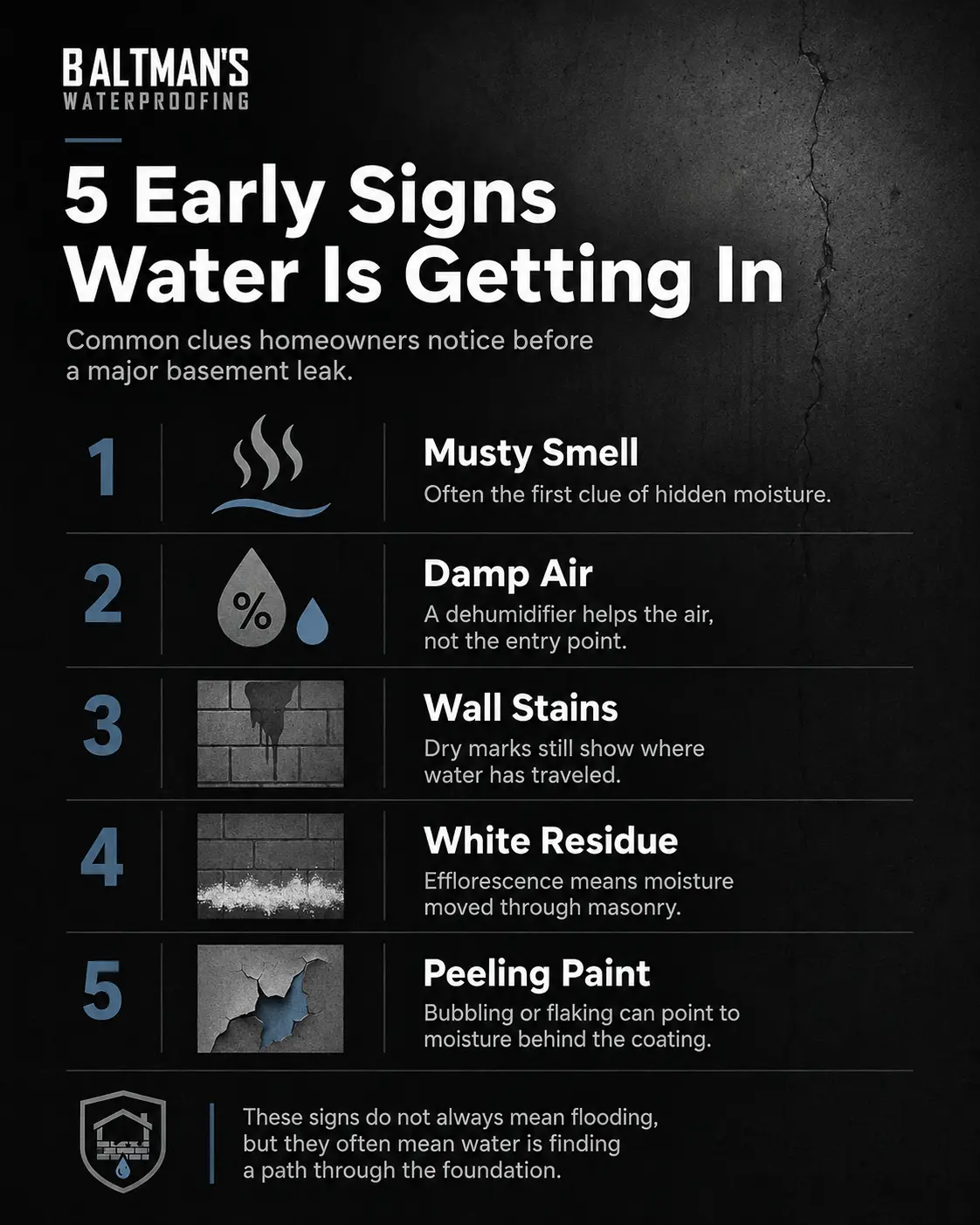
If the crack starts to behave in a way that makes it appear like it is an active part of the basement’s moisture problem, you should consider turning to professional basement crack repair in Staten Island. Water coming through the crack is the clearest sign. Others include:
- Dark staining
- White residue from mineral deposits
- Recurring dampness
- Peeling paint nearby
- Soft wood or drywall near the crack
- Musty odors
Crack shape and movement matter, too. If you notice any of the following, a DIY patch job will probably not be enough. They might be signs of serious structural stress, not just surface separation.
- Horizontal cracks
- Stair-step cracks in block walls
- Widening cracks
- Cracks with displacement
- Bowing walls
- Any other indications that the wall is shifting
The University of Minnesota Extension explains that concrete and concrete block foundations commonly develop cracks, but some can be severe when wall movement or settlement is involved.2 It also identifies foundation cracks as one possible part of basement moisture problems. An expert can thoroughly examine the area to see the extent of the issue.
Moisture Changes the Decision
A dry crack and a damp crack are not the same problem. Once moisture is involved, the question becomes less about filling a gap and more about stopping the source of indoor dampness. That is where judgment matters.
According to the Environmental Protection Agency, moisture control is the key to mold control; water problems must be fixed rather than only cleaned up after the fact.3 Mold will not grow without water or moisture, so recurring dampness along a crack should be treated as a condition to correct, not just a stain to hide.
This does not mean every damp crack has caused mold or will become a major repair. It does mean that a leaking crack is part of the home’s indoor environment. If the wall keeps getting wet, nearby materials may also stay damp.
The Real Difference: Covering a Crack Versus Repairing a Water Path
The main issue is not whether a homeowner can buy a patching material and apply it neatly. Many can. The issue is whether the repair reaches the actual path water is using.
A crack may extend through the wall thickness. If the repair only sits on the inside face, the deeper break can remain open. Water can continue moving behind the repair until it finds another weak spot or pushes the patch loose. That is why a crack may look “fixed” for a while and then reopen after a hard rain.
Professional crack repair should evaluate the whole condition, not just the visible line. That includes the crack’s width, direction, depth, leakage history, surrounding wall condition, and any signs of movement. In other words, the goal is to understand what the crack is doing before choosing how to repair it.
How Altman’s Approaches Leaking Basement Cracks
Altman’s Waterproofing treats leaking foundation cracks as paths through the basement wall rather than surface blemishes. We use epoxy injection to fuse concrete back together, sealing leaks without excavation.
That approach fits the real decision homeowners face. If the problem is only the visible face of the wall, a surface repair may be enough. If the problem is a crack that carries moisture through the foundation, the repair needs to address both the wall thickness and the water path.
Altman’s method does not just make a crack look cleaner. It treats a leaking crack as a structural break that needs to be sealed and reinforced from inside the basement. It does so by unifying the concrete across the wall's thickness rather than hiding the opening.
We Will Be Ready When You Need Us
For homeowners comparing DIY patching with basement crack repair in Staten Island, remember that small, dry, stable cracks may be watched or lightly patched. However, leaking or changing cracks need source-level repair. A contractor like Altman’s is the right call when the crack is no longer just a line in the concrete, but evidence of water moving through the foundation.
Sources:
1 https://www.nrmca.org/wp-content/uploads/2021/01/07pr.pdf
2https://extension.umn.edu/moisture-and-mold-indoors/moisture-basements-causes-and-solutions
3https://www.epa.gov/mold/brief-guide-mold-moisture-and-your-home
Related Reading