How Water Actually Gets In, Why Winter Makes It Worse, and How to Stop Treating Symptoms
Most Staten Island homeowners do not panic the first time they see a damp basement floor. What creates panic is the pattern that follows. Water shows up where it does not belong, near drywall, stored belongings, mechanical systems, and finished spaces. Then it shows up again. And again. The uncertainty is often worse than the water itself. Is this normal winter moisture, or the start of a much bigger problem?
Winter basement water problems are rarely random. They are the result of water volume, timing, and pathways aligning in a way that exposes weaknesses most homes already have. Winter does not create those weaknesses. It simply applies pressure to them.
Understanding that distinction is the difference between fixing the problem and chasing it for years.
Why Winter Causes Basement Water Problems on Staten Island Homes
Staten Island’s winter water issues are not just about snow. They are about how water behaves when the ground is cold, saturated, and receiving precipitation in short, intense cycles. Snowmelt combined with rain places sustained pressure on soil around the foundation. When soil stays saturated, it loses its ability to absorb additional water efficiently. That excess water has to move somewhere, and gravity always pushes it toward the lowest point, which is the basement.
This is compounded by how many Staten Island neighborhoods are built. Large sections of the borough sit near streams, wetlands, or former waterways that now function as drainage corridors. Even when surface flooding is not visible, subsurface water movement still exists. In winter, that movement slows and becomes more concentrated, increasing pressure on foundation walls and floor joints.
The result is not always dramatic flooding. More often, it is subtle seepage that repeats under the same conditions. Homeowners notice it only after enough damage accumulates to make it impossible to ignore.
Why Basement Water Keeps Coming Back After You Dry It Out
The instinctive response to basement water is to focus on removal rather than prevention. Pumps are installed. Fans are run. Dehumidifiers are purchased. These tools can be useful, but they do not answer the most important question: why is the water entering the basement in the first place?
Water does not appear indoors without a pathway. It follows pressure gradients, gravity, and material weaknesses. If those pathways are not identified and addressed, removing the water only resets the clock until the next storm or thaw cycle.
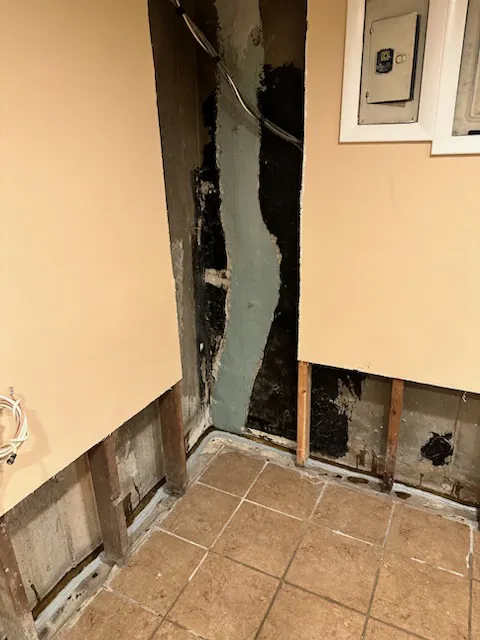
Winter makes this mistake more expensive. Moisture trapped behind finished walls, beneath flooring, or inside masonry foundations can lead to mold growth, material deterioration, and structural stress long before visible water becomes severe.
How Roof Runoff and Surface Water Lead To Basement Leaks in Winter
One of the most overlooked contributors to winter basement water is roof runoff. A roof sheds hundreds of gallons of water during a single melt or rain event. If that water is not carried far enough away from the foundation, it becomes part of the soil mass pressing directly against basement walls.
Clogged gutters, short downspouts, frozen discharge points, or improper grading all concentrate water at the foundation line. In winter, this effect is amplified because partially frozen soil limits absorption. Water pools, saturates the soil, and increases hydrostatic pressure against the structure.
This explains why basement leaks often appear quickly during melt events, sometimes within minutes. The issue is not the basement itself. It is the volume of water being intentionally deposited next to it.
Watching the exterior of the home during a thaw or heavy rain is often more revealing than any interior inspection. If water is pooling near foundation walls or flowing toward basement windows, that behavior is not incidental. It is causal.
Why Basement Windows and Window Wells Fail During Snow Melt
Basement windows are frequent failure points because they sit below grade and are surrounded by window wells designed to keep the soil open. During snowmelt, water naturally flows toward these depressions. If the well does not drain properly, it fills.
Once water reaches the height of the window frame, it exploits weaknesses in seals, masonry joints, or aging materials. This usually presents as localized water beneath a window, which leads many homeowners to assume the window itself is the primary issue.
In reality, the window is often the final link in a longer chain. Surface water routing, grading, and drainage capacity determine whether that well ever fills in the first place. Replacing a window without addressing how water reaches it rarely produces a lasting fix.
When Basement Water Means Groundwater Pressure or Foundation Crack Repair Staten Island
When water enters along the seam where basement walls meet the floor, or through visible cracks in foundation walls, the issue is rarely surface splash or window failure. This pattern indicates groundwater pressure acting against the foundation.
During winter, prolonged saturation from repeated melt cycles raises groundwater levels around the home. Concrete and masonry are not waterproof materials. They resist structural loads, not water intrusion. Under pressure, water seeks the path of least resistance, which often includes hairline cracks, porous block, and wall-to-floor joints.
This is where foundation crack repair Staten Island homeowners often search for becomes relevant, but crack repair alone only works when the crack is the true entry point and not a symptom of broader pressure. Sealing a crack without reducing exterior water load is like patching a hole in a boat without addressing why the water keeps rising.
Effective foundation crack repair depends on understanding whether the crack is structural, stress-related, or simply a release point for water forced inward by saturated soil.
Why Sump Pumps Do Not Fix the Root Cause of Basement Water
Sump pumps are commonly misunderstood. A sump pump does not prevent water from reaching your foundation. It removes water that a drainage system has already collected.
In winter, sump systems face additional stress. Discharge lines can freeze. Power outages can disable pumps during storms. Pumps that run constantly during thaws often indicate excessive water pressure rather than system success.
A sump pump should be the final safeguard in a larger water management strategy. When installed without addressing roof runoff, grading, groundwater pressure, or foundation weaknesses, it often masks problems rather than solving them.
How to Think About Winter Basement Water Problems the Right Way
The most reliable way to solve winter basement water problems is to stop thinking in terms of individual products and start thinking in terms of systems. Water follows predictable rules. When you understand where it originates, how it moves, and where it is being allowed to collect, the correct solutions become clear.
For Staten Island homeowners, this means looking beyond the basement walls. Roof runoff, grading, groundwater behavior, foundation condition, and local drainage all interact during winter. Addressing only the visible symptom is why so many homeowners experience the same problem year after year.
A dry basement is not achieved by reacting to water once it appears. It is achieved by preventing water from becoming an indoor problem in the first place.
Related Reading