How to Tell If a Basement Wall Crack Is a Serious Problem
Evaluating Basement Wall Cracks
How can homeowners determine whether a crack in a basement wall is harmless settling or a sign of serious foundation trouble? When researching local waterproofing companies Staten Island property owners frequently encounter confusing contractor advice and conflicting repair estimates. In reality, most basement wall cracks in poured concrete foundations are common drying-shrinkage marks that only require sealing to prevent water leaks. Learning how to identify different crack directions, recognize warning signs of structural movement, and ask the right questions helps property owners protect residential buildings with complete confidence.
Noticing a new crack in a foundation wall can alarm any property owner. Thoughts quickly jump to catastrophic structural failure, shifting foundations, and massive repair estimates from aggressive contractors. However, a methodical approach to evaluating crack patterns shows that most wall cracks are straightforward maintenance issues rather than structural emergencies.
Homeowner Fundamentals: Why Concrete Foundation Walls Crack
Finding a crack in a concrete basement wall is naturally concerning, but cracks are common in concrete construction. As fresh concrete cures during home construction, large amounts of water evaporate, causing the material to shrink slightly. This natural curing shrinkage generates internal tension that relieves itself by opening narrow vertical hairline fractures down the wall.
In addition to curing shrinkage, newly built homes undergo minor settling as the structure's weight presses down into the underlying soil. If soil conditions vary slightly from one corner of the foundation to another, minor hairline cracks can develop near corners or around basement window cutouts. In most cases, these settling cracks stabilize quickly once the building settles into its permanent footprint.
Because concrete is exceptionally strong under vertical downward weight but relatively brittle under lateral tension, small cracks often develop without compromising the building's overall stability. The primary concern with hairline settling cracks is usually not that the house will collapse, but that seasonal groundwater will use the opening as an easy doorway into the basement. Distinguishing between cosmetic water pathways and active structural displacement ensures repairs stay appropriate and cost-effective.
Why Common Advice About Foundation Cracks Is Often Wrong
Property owners can learn a great deal about a foundation crack simply by observing the direction and location of the fracture along the wall. Structural inspectors and waterproofing contractors generally categorize basement fractures into three common patterns. Avoiding common diagnostic mistakes helps homeowners determine whether a crack requires simple waterproofing or structural stabilization.
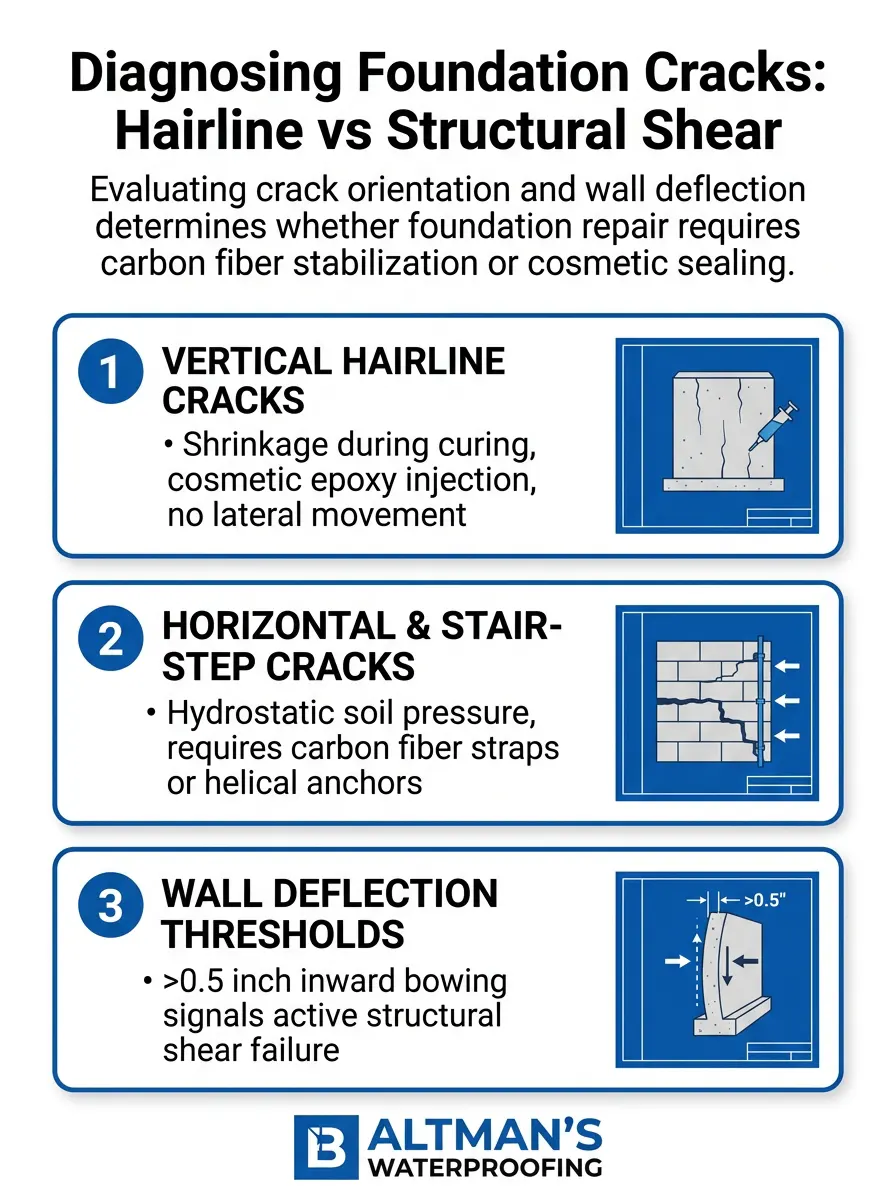
- Vertical Hairline Cracks: These run straight up and down or slightly diagonally across the wall. They are the most common crack type in poured concrete, almost always caused by curing shrinkage, and pose no structural danger even though they frequently leak water.
- Diagonal Cracks Near Corners: These typically start near basement windows or foundation corners and run down toward the floor. They usually result from minor foundation settling, and as long as one side isn't shifting outward, you can permanently seal the crack with epoxy.
- Horizontal Cracks Across the Middle: These run horizontally across the center or upper third of the wall. Horizontal cracking is a serious structural warning sign indicating that heavy, saturated soil outside is pushing the wall inward.
Understanding these three patterns allows property owners to assess foundation walls calmly and objectively. While vertical and diagonal hairline cracks require straightforward crack sealing to keep basements dry, horizontal cracking demands immediate structural reinforcement to stabilize the wall against outside soil forces. Recognizing the difference protects property owners from being persuaded into expensive structural repairs when simple crack fusion is all that is required.
Clear Warning Signs That Require Immediate Attention
While most cracks are purely cosmetic, certain visible symptoms indicate that a foundation wall is experiencing active structural movement. Identifying these warning signs early allows property owners to address foundation movement before damage spreads to upper living levels. Prompt intervention prevents localized foundation displacement from affecting framing, finishes, and interior utilities.
The most critical warning sign is inward wall bowing or deflection. If a foundation wall begins bulging inward toward the basement room, lateral earth pressure from heavy clay soil is overloading the concrete. Property owners can check for inward movement by placing a long level or straight mason's line vertically against the wall face to see if the center curves inward away from the top and bottom.
Another important indicator is shear displacement, which occurs when one side of a horizontal crack sticks out past the other side when running a hand across the seam. Property owners should also check upper floors for secondary symptoms, such as interior doors that suddenly stick in frames, sloping floors, or new drywall cracks appearing above door openings directly over the basement fracture. When horizontal cracking is accompanied by inward bowing, install carbon fiber reinforcement straps or steel supports to lock the wall in place permanently.
How Professional Waterproofers Solve Different Foundation Crack Problems
Crack Type & Direction | Structural Danger Level | Recommended Repair Method | What the Repair Accomplishes |
Vertical Hairline Crack | Low / Cosmetic water leak hazard | High-pressure liquid epoxy injection | Seals full wall thickness; permanently stops water entry |
Diagonal Settling Crack | Low to Moderate; depends on movement | Full-depth structural epoxy fusion | Bonds concrete together and prevents future water seepage |
Horizontal Mid-Wall Crack | High; indicates inward soil pressure | Carbon fiber reinforcement straps & epoxy | Halts inward wall movement and restores structural stability |
Floor-Wall Seam Seepage | Low structural risk; high moisture risk | Perimeter pressure relief drainage system | Captures rising water table before it pools on basement floor |
Ask the Right Questions Before Hiring a Waterproofing Contractor
When interviewing waterproofing contractors, property owners should ask specific questions to ensure an honest diagnosis and appropriate repair, not an unnecessary, overpriced sales pitch. Asking targeted diagnostic and warranty questions ensures transparency before signing any service contract. Reputable contractors welcome these inquiries and provide clear, straightforward answers without high-pressure sales tactics.
- "Will this repair seal the crack through the entire wall thickness?" Reputable contractors use pressure injection to fill the crack from front to back, rather than just smearing hydraulic cement over the interior surface.
- "Does the foundation show any measurable inward bowing?" A trustworthy inspector will measure wall plumbness with a level or laser rather than guessing, confirming whether the wall needs structural bracing or simply waterproof crack sealing.
- "What specific warranty comes with the repair?" Look for written warranties that specifically guarantee the repaired crack will remain watertight and that are transferable if the property is sold in the future.
A reputable waterproofing specialist will take the time to explain findings clearly, show where water is entering, and recommend the least invasive repair that solves the problem permanently. If a contractor insists that a simple hairline crack requires tens of thousands of dollars in perimeter yard excavation, getting a second opinion is always wise. Informed property owners make better decisions that protect both household budgets and the long-term equity of residential buildings.
Protecting Staten Island Homes with Altman's Waterproofing
Discovering a crack in a basement wall can feel stressful, but having an experienced, honest evaluation quickly puts the situation into perspective. Most poured concrete cracks can be repaired cleanly and permanently from the inside without high costs or disruptive excavation. Choosing a specialized contractor who understands foundation mechanics ensures your home gets an exact, lasting solution.
Related Reading Foundation Cracks Staten Island

 The first line of defense against foundation cracks Staten island is damp proofing. This waterproofing method is applied to a home while it is being built.