You might think that a puddle is the most obvious sign of a leak in your basement, but it is the result, not the cause. Something much more subtle is going on. The first warning may be a musty smell after heavy rain, a stain near the floor, white powder on concrete, or paint that keeps bubbling in the same place.
These clues mean different things. For example, the smell could mean there is something behind the wall that is always damp. The stain could be a remnant of the last heavy rain, even if the surface has been dry for a long time. The white powder might mean water has moved through the masonry.
All of the above show that water is finding a path through your home’s foundation. If you are thinking of calling Altman’s for basement waterproofing in Staten Island, flooding is not the biggest question. The real question is whether the basement can provide clues about where water is moving in places it should not.
The Dreaded Musty Smell – the First Indication of Hidden Moisture
Basements often have a smell distinct from the rest of a home, typically because of their contents. Where else will you usually find old furniture and stored boxes? Also, humidity and poor airflow can contribute to the normal smell. But if you notice a musty odor that keeps coming back, that is a problem.
Most of the time, you will notice this odor in your basement before you see water. You might want to place a lot of the blame on old items you are storing or poor ventilation. But while those can be contributing factors, the smell could also mean moisture is trapped in the basement’s structure. Flooring, insulation, wood, drywall and masonry could hold moisture entering through cracks, porous walls or other problems that are hard to see.
The EPA recommends controlling indoor moisture in part because damp conditions can encourage mold growth.1 It is not enough to simply cover up the smell, because that does not explain why it is happening.
Why Does That Damp Air Return? It Is Not Always Due to Humidity
If you have a dehumidifier in your basement, that will make the air feel better. It might even eliminate the musty odor mentioned above. However, it cannot do the following:
- Seal a foundation crack.
- Repair a concrete separation.
- Stop seepage at a wall-floor joint.
- Keep water from passing through porous masonry.
Also, that dehumidifier might only be removing water from the air after the basement has already absorbed the liquid. That is especially the case if the moisture enters through the wall or where the wall and floor meet.
There are lots of paths moisture can take on its way to your basement. The University of Minnesota Extension identifies basement walls, joints, and foundation cracks as common moisture routes.2 If you consistently feel your basement has a clammy feeling, even if you use a dehumidifier, it might be time to contact a professional to see if your home is a candidate for basement waterproofing in Staten Island.
Stains Can Show Where Water Has Been
A stain on a basement wall is easy to ignore when the surface feels dry, but it can still tell a useful story. Water may enter during rain or snowmelt, or when the soil is saturated, and then evaporate before anyone notices an active leak.
These are a few of the ways that the clues stains provide can indicate the source of an issue:
- A mark spreading from a crack may connect the opening to the leak.
- Darkening near the floor may point to the wall-floor joint.
- A stain behind paneling may show that water traveled before becoming visible.
Again, though, the visible stain is rarely the whole problem. A professional interior evaluation looks at where the stain appears, what materials surround it, and how water may be reaching that location from inside the basement.
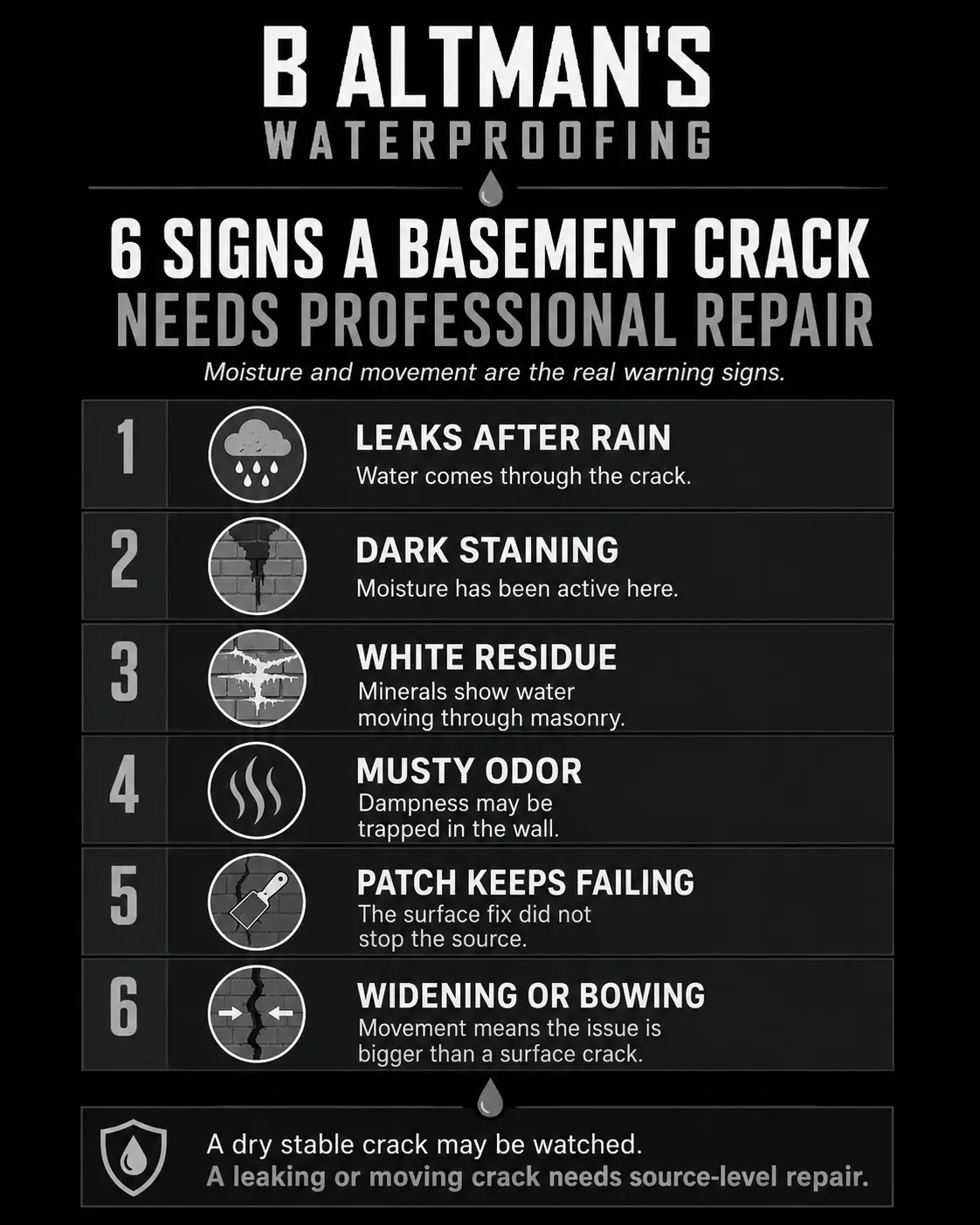
White Residue On Masonry Could Mean You Have Moisture Seeping Through a Wall
Efflorescence occurs when a residue that looks like white powder appears on brick, stone or block. The reason it forms is that moisture is moving through the masonry. As it dries, moisture leaves behind mineral deposits, resulting in the residue you see. You could easily wipe it away, and it would be understandable to assume the problem is gone. However, the movement of moisture that causes the residue is likely still happening.
Walls and footings, according to the U.S. Department of Energy, often absorb moisture from the ground.3 That is important because basement walls are constantly in contact with soil. These walls are often made from porous materials that attract water. Watch whether the residue:
- Returns after being removed.
- Becomes heavier after rain.
- Spreads across the wall.
- Appears near a crack or joint.
But please do not assume that when you see white residue, that automatically means you have a serious leak. What it does mean, however, is that you should watch the area closely. If that residue comes back, shows up near cracks, or spreads, that probably means the moisture is using the wall to infiltrate your basement.
Peeling Paint and Bubbling Coatings Can Hide the Real Issue
Not only should you pay attention to stains and white residue, but paint can also indicate water intrusion. You might view flaking, peeling, or bubbling paint in your basement as only a surface issue. You scrape the wall, apply primer, and repaint the area, only to watch the same spot fail again.
When that happens, something behind the coating may remain unresolved.
A fresh coat will look better, but it will not stop moisture from continuing to encroach. It will basically just conceal the early signs of deterioration. It will not address deeper problems, such as:
- Cracks
- Separations
- Porous masonry
- A weakened foundation
This is where inside structural waterproofing differs from cosmetic treatment. Altman’s experts evaluate the basement from the inside, look for the weak point, and consider how water is entering rather than simply covering the wet area.
When Does a Small Sign Need Professional Attention?
Altman’s does not assume that every damp basement needs the same repair. For foundation cracks and faults, we use industrial, high-strength liquid epoxy injection. The epoxy fills the wall's depth and thickness, fusing the concrete like structural glue.
The goal is not to fill only the crack you can see. We use the epoxy to reach through the wall’s thickness, reinforce the damaged concrete, and avoid the short life of a foam repair or surface patch. We also back our work with a lifetime transferable warranty.
For basement waterproofing in Staten Island, we look beyond the stain, odors, or peeling paint to determine what is happening inside the wall and choose the repair that addresses the actual problem.
Sources:
1 https://www.epa.gov/mold/brief-guide-mold-moisture-and-your-home
2 https://extension.umn.edu/moisture-and-mold-indoors/moisture-basements-causes-and-solutions
Related Reading