
A wet basement can look like one problem from inside the house: a puddle near a wall, damp carpet, musty air, or staining along the foundation. Outside the basement, however, the water may have followed very different paths before appearing indoors. Some leaks begin as surface water moving across roofs, patios, driveways, yards, and foundation edges, while others come from groundwater pressing against below-grade walls and slabs.
That distinction matters for basement waterproofing Staten Island homes because many local properties have tight lots, older foundations, paved surfaces, sloped grades, and limited areas for stormwater to disperse. Choosing a repair before identifying the water source can reduce a symptom while leaving the active path untouched. Altman's Waterproofing uses an inspection-first approach because surface runoff and groundwater pressure behave differently and require different waterproofing strategies.
Surface Water Leaks Start with Runoff Patterns
Surface water is usually connected to rainfall, roof discharge, paved areas, yard pitch, or exterior drainage points. In Staten Island, runoff can move quickly across compacted soil, concrete walkways, driveways, patios, and basement stairwells before collecting against the foundation. When enough water sits beside a wall, it searches for the easiest opening, such as a crack, pipe penetration, cold joint, window well, or the seam where the wall meets the slab.
Surface runoff isn't random nuisance water because exterior drainage follows a path you can trace from the roofline, pavement, or yard to the foundation edge. For Staten Island basement diagnosis, that pathway matters as much as the indoor stain because the visible leak may only be the last step in a longer drainage problem. Tight lots, paved surfaces, and neighboring grades can change how water reaches one side of a home. New York City drainage requirements reinforce that runoff must be managed intentionally, not allowed to collect wherever gravity sends it. NYC Plumbing Code §1101.2 states that "all roofs, paved areas, yards, courts and courtyards" must drain to a separate storm sewer, combined sewer, or commissioner-approved disposal location in accordance with NYC DEP requirements. That code context does not diagnose a specific basement leak by itself, but it supports the practical point that roof water, paved-area runoff, and yard drainage are part of the waterproofing picture. For basement waterproofing Staten Island properties, inspections should connect exterior discharge patterns to interior seepage before choosing any repair method. Several site conditions tend to concentrate that load against basement walls.
- Roof water discharging too close to the foundation
- Soil pitched toward basement walls instead of away from them
- Driveways, patios, or walkways sending runoff toward low areas
- Window wells or stairwells acting as collection basins
- Clogged, undersized, or poorly placed exterior drains
These conditions often create leaks that appear during heavy rain or shortly after a storm begins. The basement symptom may be located inside, but the cause may sit several feet away at the grade, roofline, pavement edge, or drainage outlet. A diagnosis that stops at the visible wet spot can miss the exterior movement that keeps delivering water to the same foundation area.
Groundwater Leaks Come from Saturated Soil and Pressure
Groundwater behaves differently because it does not depend on an obvious downspout problem or visible yard slope. After repeated rain, snowmelt, or long damp periods, the soil around a foundation can become saturated enough to push water inward from the sides or upward from below. That force is commonly called hydrostatic pressure, and it can drive moisture through joints, cracks, porous masonry, and slab edges.
A basement can have reasonable grading and clean gutters while still taking in water from pressure below grade. In many Staten Island homes, the buried portion of the foundation is exposed to moisture that is not visible from the surface. The puddle or stain is only the final sign of a larger pressure condition developing around the foundation envelope.
Groundwater symptoms often separate from surface-water symptoms by timing, location, and recurrence. The pattern is not always perfectly clean because a property can have both runoff and pressure problems at the same time. Still, the timing of seepage and the point of entry can guide the inspection toward the most likely water behavior.
Basement symptom | More likely concern |
Water appears during intense rainfall | Surface runoff, roof discharge, grading, or paved-area drainage |
Water appears after several wet days | Soil saturation and hydrostatic pressure |
Seepage occurs at the floor-wall joint | Pressure beside or beneath the foundation |
Patched cracks leak repeatedly | Water load may not have been relieved |
Dampness appears in multiple low points | Broader below-grade moisture pressure |
These patterns don't prove the source on their own, but they help guide the inspection. Water that arrives immediately during a storm often suggests runoff moving toward the foundation, while seepage that appears later may suggest saturated soil pressing inward. Altman's Waterproofing evaluates timing, entry points, wall materials, slab conditions, and prior repair attempts before matching a waterproofing method to the problem.
Why the Same Wet Wall Can Need Different Fixes
A wet basement wall can look similar whether the cause is misdirected surface water or groundwater pressure. In both cases, moisture may appear along a crack, near a pipe penetration, at the wall-floor joint, or behind finished basement materials. The difference is that surface water usually needs to be intercepted, redirected, or drained before it collects at the foundation. At the same time, groundwater pressure may require a strategy that addresses below-grade saturation and pressure relief.
This is why basement waterproofing in Staten Island should begin with diagnosis rather than an instant repair recommendation. Exterior runoff, roof discharge, grading, paved surfaces, foundation materials, and interior seepage patterns all belong to the same investigation. If the diagnosis treats pressure-driven seepage as a simple runoff issue, or treats runoff as a foundation-only failure, the basement may still show dampness after the work is complete.
The inspection-first angle matters most in neighborhoods where homes sit close together, and stormwater has limited space to spread out. Paved surfaces can speed water toward a foundation, while older masonry can provide more entry points once water accumulates. A sound waterproofing plan must match the path water takes, not just where it becomes visible indoors.
Inspection before Waterproofing Decisions
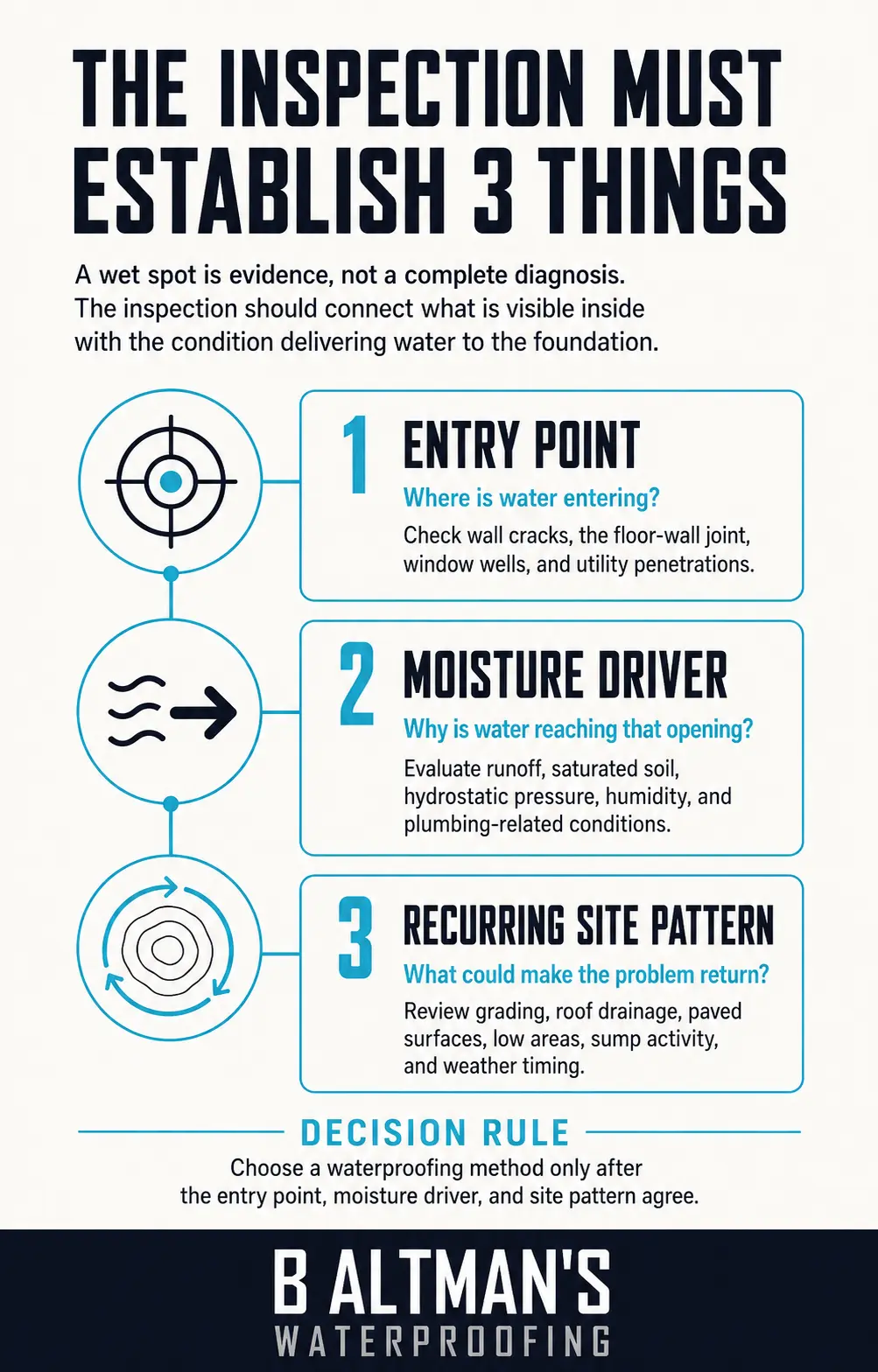
A Staten Island basement with recurring dampness should be evaluated before a waterproofing method is selected. Surface runoff and groundwater pressure create different risks, and the right approach depends on whether water arrives from above-grade drainage patterns or building pressure below grade. Roof discharge, paved areas, soil pitch, stairwells, window wells, cracks, joints, and slab edges all provide clues that need to be read together.
An educational inspection does more than confirm that moisture exists. It identifies when water appears, where it enters, how it moves, and whether previous patching has addressed the source or only the symptom. With Altman's Waterproofing, the goal is to connect the visible basement condition to the actual water pathway so the waterproofing direction fits the property rather than relying on guesswork.
Related Reading