
If you are comparing waterproofing companies Staten Island homeowners rely on, you may hear the same recommendation more than once: install an interior French drain. That can sound like a complete basement waterproofing solution. In some homes, it may help manage recurring water. But it is important to understand what a French drain does before you agree to one.
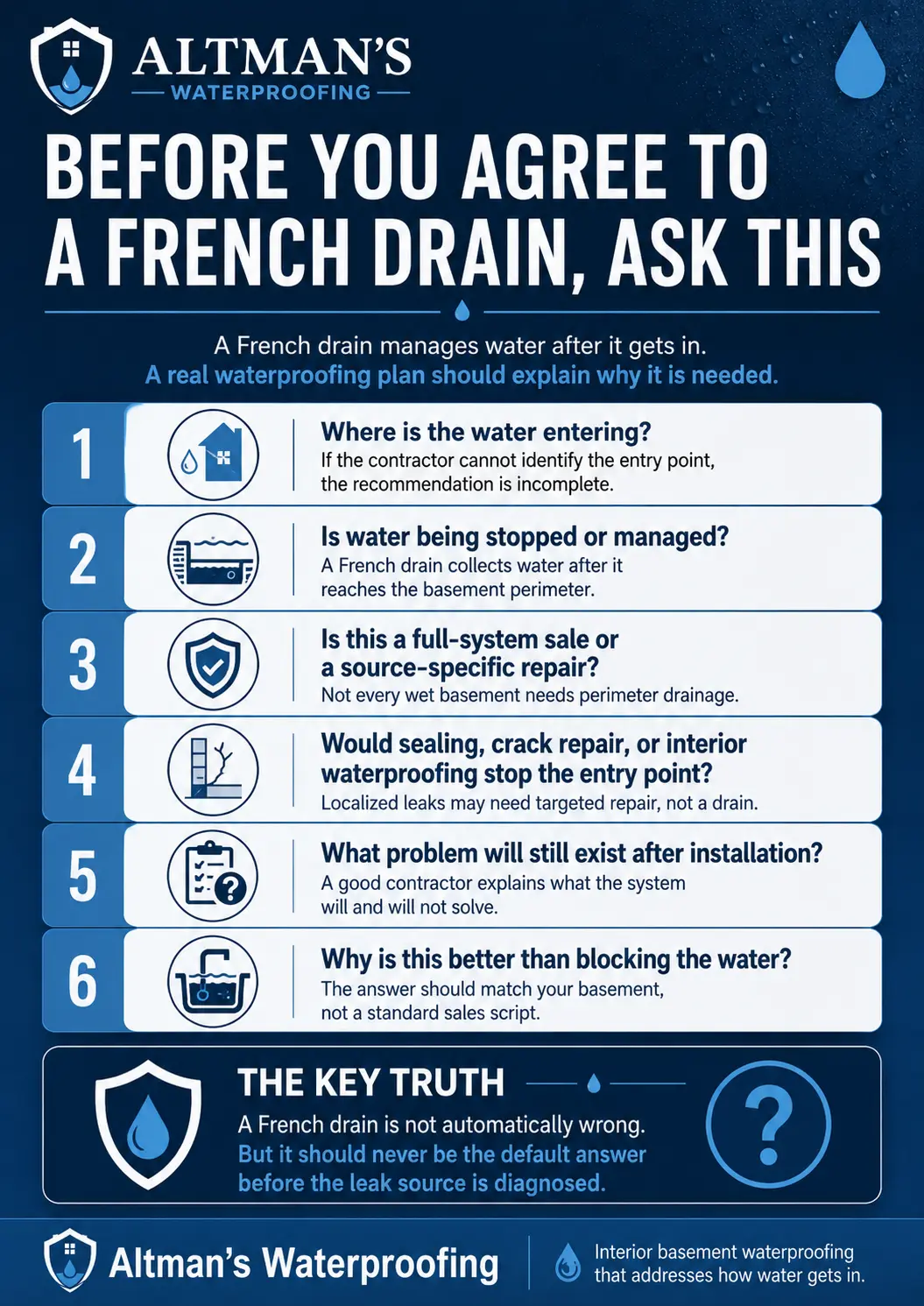
An interior French drain does not prevent water from entering the basement. It collects water after it reaches the perimeter. A proper inspection should identify the leak source-whether from cracks, grading, or gutters-so you can choose the most effective solution.
Why Some Waterproofing Companies Staten Island Homeowners Call Recommend French Drains
Some waterproofing companies recommend interior French drains because they provide a reliable way to manage water along the basement perimeter. If water reaches the wall-floor joint, collects near the footing, or enters several areas after storms, a drain can collect that water and direct it to a sump pump.
That does not mean every wet basement needs one. A French drain can become the default recommendation when the contractor focuses on managing water after it enters rather than identifying how it gets in. That is where homeowners need to ask better questions and consider targeted repairs instead.
When a French Drain May Be Discussed
A contractor may mention an interior French drain when:
- Water appears along the wall-floor joint.
- Water returns after heavy rain.
- Several basement perimeter areas get wet.
- The basement has recurring floor seepage.
- A sump pump is already part of the home’s water-control system.
- Exterior excavation is difficult because of driveways, patios, steps, or tight property lines.
These conditions may support a drain recommendation. They do not prove that a drain is the best or only solution.
What an Interior French Drain Actually Does
An interior French drain is installed along the inside perimeter of the basement floor. The floor is opened near the wall-floor joint. Drainage stone and perforated pipe are installed below the floor line. Water moves through that drainage area and flows toward a sump basin. The sump pump then moves the water away from the home.
An interior French drain manages water once it reaches the basement, but it doesn't prevent water from entering or fix every crack or point of seepage. Homeowners should understand that it's not a complete waterproofing solution, and external issues may still allow water to enter.
The Key Point Homeowners Need to Understand
A French drain:
- Manages water after it gets in.
- Does not stop water from getting in.
- Depends on the sump pump and discharge route.
- May still leave the original entry issue unresolved.
- Should be recommended only when the leak pattern supports it.
That does not make it useless. It means the recommendation needs to be specific. A contractor should explain why managing water after entry is the right approach for your basement.
What a French Drain Does Not Fix
A French drain can move water away from the basement floor, but it does not solve every water problem. If the source of water is a wall crack, window well, pipe penetration, grading issue, gutter problem, or exterior drainage failure, a drain may only manage part of the symptom.
Problems a French Drain Does Not Fix by Itself
A French drain does not fix:
- Active foundation cracks.
- Bowing or shifting foundation walls.
- Water entering through a window well.
- Poor exterior grading.
- Short downspouts dumping water near the foundation.
- Wall seepage that can be sealed at the entry point.
- Plumbing leaks.
- Humidity caused by poor ventilation or damp materials.
- Exterior surface water should be redirected before it reaches the foundation.
This is why diagnosis matters. A homeowner should not accept a French drain recommendation unless the contractor can explain which problem it solves and which it does not.
When a French Drain May Be Overkill
Some basement leaks are localized. A single active crack, a pipe penetration leak, a small wall seepage point, or water entering from a window well may need targeted repair. In those cases, a full perimeter drain may be more work than the problem requires.
A serious waterproofing inspection should separate a source-specific repair from a full-system sale. Not every wet basement needs perimeter drainage.
Signs the Basement May Need Targeted Repair Instead
A French drain may be overkill when:
- Water enters from one visible crack.
- The leak starts at a window well.
- Water appears only near one pipe penetration.
- The issue is tied to a gutter or downspout problem.
- A wall space can be sealed directly.
- The basement has no recurring perimeter water pattern.
- The contractor cannot show why a full drainage system is needed.
Why Blocking Water Matters
Many homeowners think basement waterproofing means installing a drain. That is not always true. The better question is whether water can be blocked, sealed, redirected, or otherwise controlled at the point of entry before it spreads.
Interior basement waterproofing can involve several approaches, depending on the source of the leak. The right repair may involve sealing an active crack, treating a wall-floor joint issue, addressing porous masonry, improving water control around a specific entry point, or pairing interior waterproofing with sump support when the leak pattern calls for it.
The goal is not to pretend every basement can be fixed with one method. The goal is to avoid accepting water into the basement area when the entry point can be addressed more directly.
Signs You Need a Diagnosis-First Waterproofing Plan
Basement water problems are not always dramatic. Sometimes the signs are small at first. A damp lower wall, a musty smell, bubbling paint, or white mineral residue may point to a moisture pattern that has been building over time.
You should request a full waterproofing inspection if you notice repeated symptoms, even if the basement is not flooding. Small signs often show where water has been entering, evaporating, and returning over time.
When Interior Drainage (French Drains) May Make Sense
Interior drainage is not always wrong. In some basements, it may be a practical way to manage water that cannot be fully stopped at one entry point.
The difference is proof. A French drain should be recommended because the basement conditions call for it, not because it is the company’s default system.
Conditions That May Support Interior Drainage
Interior drainage may make sense when:
- Water enters several sections of the perimeter.
- The wall-floor joint leaks repeatedly after storms.
- Hydrostatic pressure is pushing water near the footing.
- Exterior excavation is not practical.
- The basement needs a sump-based water-control system.
- Other entry-point repairs would not address the full leak pattern.
- The contractor explains the limits clearly.
How Altman’s Waterproofing Approaches Interior Basement Waterproofing
Altman’s Waterproofing focuses on interior basement waterproofing that starts with understanding how water gets in. That means the first step is not assuming every basement needs a French drain. The first step is to identify the entry point and explain which repair best fits the condition.
Some basements need targeted crack repair. Some need wall-floor joint work. Some need interior waterproofing to block or control seepage at the source. Some need sump support. Some may need drainage if the water pattern proves that a drain is the right tool.
The Altman’s Difference
Altman’s focuses on:
- Finding the leak source first.
- Explaining whether water is being stopped or managed.
- Avoiding one-size-fits-all recommendations.
- Using interior waterproofing where it fits the entry point.
- Recommending drainage only when the leak pattern supports it.
- Explaining what each repair will and will not solve.
The point is simple. A French drain should not be the default solution before the source of the leak is diagnosed.
Talk to Altman’s Waterproofing Before You Agree to a French Drain
Interior French drains are common in basement waterproofing, but that does not always mean they are correct for your home. A French drain can manage water after it enters the basement perimeter. It does not automatically stop the source of the leak.
Before you agree to one, get a diagnosis-first inspection. Altman’s Waterproofing can evaluate your basement, identify the source of the leak, and explain whether targeted interior waterproofing, crack repair, sump support, or another approach makes the most sense.
If you are comparing waterproofing companies Staten Island homeowners trust, ask for a clear explanation before you approve any system. The right waterproofing plan should match your basement, not a standard sales script.
Related Reading