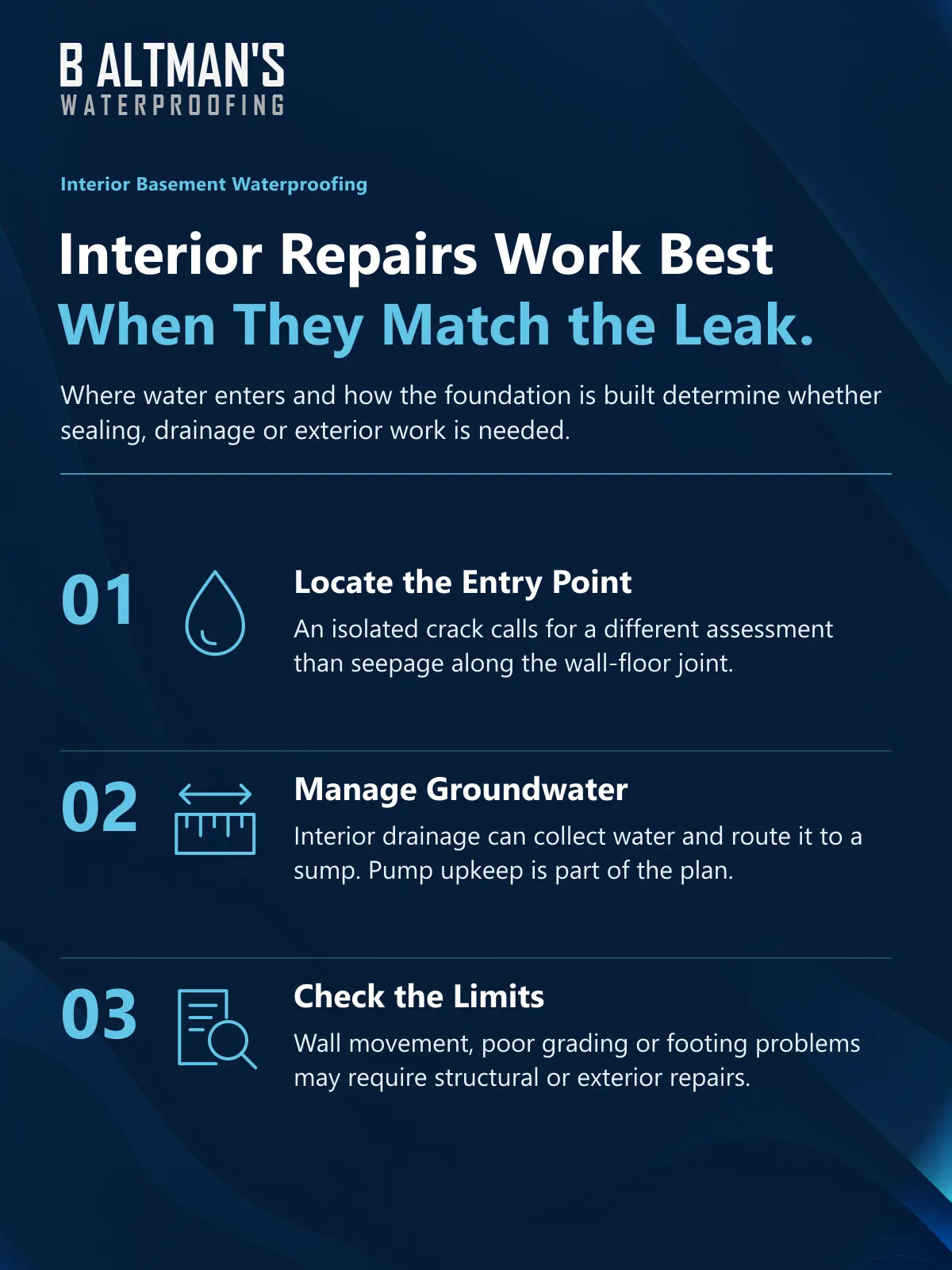
A narrow wet streak below a basement wall crack can make you picture excavators outside, broken concrete inside, and a repair bill that keeps growing. But a wet basement does not automatically mean tearing up your landscaping. Some leaks can be repaired from inside the home. The important question is whether the proposed repair addresses where your water is entering, rather than simply covering the place where you see it.
At Altman’s Waterproofing, we live and breathe basement waterproofing Staten basement waterproofing Staten Island: Our crack-repair approach uses liquid epoxy injection. That is different from painting a waterproof coating over the wall, and it is also different from installing a drainage system. We want homeowners to understand that distinction before choosing a repair. A treatment suited to an identifiable foundation crack should not be presented as the answer to every wet floor, damp wall, or musty basement.
First establish where the water starts
Think about what happens during the next heavy rain. Does a wet line begin at one visible crack, or does water appear along several stretches of the joint between the wall and floor? Is the wall dry while water collects beneath a window? Those observations give a contractor something more useful than “the basement leaks.” They help separate a localized opening from a broader water-management problem.
You do not need to diagnose the foundation yourself. From a dry, safe location, photograph the first visible entry point and note when it appears. A picture taken after the whole floor is wet may show the extent of the problem without showing its origin. Tell us whether the same area leaks every time, whether a previous patch is present, and whether the basement has finished walls concealing the foundation. Do not enter standing water where electrical hazards may be present.
The basement waterproofing Staten Island homeowners need can also involve conditions outside the room. Water discharged beside the house, runoff toward a window well, and moisture entering through a wall crack are not interchangeable problems. Indoor condensation can resemble leakage, too. Choosing a repair before distinguishing these conditions risks spending money without addressing the cause.
What an interior crack repair does
For a suitable foundation crack, injection puts repair material into the opening instead of relying only on a coating across its face. Altmans uses an epoxy-based approach for foundation crack repair. Whether that approach is suitable depends on the wall, the crack, its condition, and the reason it developed. The fact that water comes through a crack does not, by itself, establish that the crack is stable or that sealing it is the only work required.
Consider a poured-concrete wall with one identified leaking crack and no established need for broader drainage work. Evaluating that opening for repair makes more sense than assuming the entire floor must be excavated. Now consider water appearing along multiple sections of the floor perimeter. Sealing one visible wall crack would not establish that those other entry paths had been addressed. The difference is the extent and source of the leakage, not simply the size of the puddle.
Because concrete behaves differently depending on how the foundation was built, no interior repair is one-size-fits-all. Tell the contractor whether the wall is poured concrete, block, or another type of masonry, and let the inspection establish what can actually be treated. A proposal should explain what the repair covers and what conditions fall outside it.
What you observe | What the repair discussion needs to establish |
Water follows one visible wall crack | Whether that crack is the entry point and is suitable for the proposed repair. |
Water appears at several floor edges | Whether broader drainage or other water-management work is needed. |
Water collects beneath a window | Whether the window, surrounding ground, or another route is admitting water. |
A wall appears bowed or a crack is changing | Whether a qualified structural professional needs to evaluate it before a leak repair is selected. |
A dry-looking wall is not the whole result
Painting over a stain may improve how a basement looks without explaining why it became wet. The same caution applies when a repair quote focuses on a product name but says little about the opening it will treat. Ask where the contractor believes the water enters, what evidence supports that conclusion, and how the proposed work addresses it. If there is a separate runoff or structural concern, it should remain part of the conversation.
Before you approve work, ask for the repair scope and any warranty terms in writing. Make sure you understand whether the proposal covers a particular crack, a defined wall area, or something broader. Afterward, keep a record of the repaired area during the conditions that previously caused leakage. That gives you and the contractor a practical basis for discussing any remaining problem.
Find out whether an inside repair fits your leak
Yes, basement waterproofing can sometimes stop a leak from inside your Staten Island home. The strongest candidate is an identified entry point that the selected repair can address, not simply any basement that happens to be wet. Multiple water paths, outside drainage problems, or signs of wall movement can change the scope.
Call Altmans Waterproofing at 917-681-3146 to discuss your leaking basement. Tell us where the water first appears and whether you can see a crack, and have your photographs ready. We can discuss our crack-repair service and the next step for evaluating whether it fits the problem in your home.
Related Reading